Is Buying Guest Posts Safe? What Google Says and How to Reduce the Risk
Last updated: October 25, 2026
Anyone who looks at paid guest posts ends up asking the same thing sooner or later: will this get me in trouble with Google? The honest answer is not a plain yes or no, and anyone who promises a link with zero risk is not being straight with you.
This guide goes through what Google actually says about buying links, where the real danger comes from, and what you can check before you pay. It also explains how we handle it at Markentrax, so you can judge for yourself.
Is buying guest posts safe? The short answer
It carries some risk, and the size of that risk depends on how the link is placed and marked. Google’s spam policies treat buying links for ranking purposes as link spam, and that includes paying for a post that contains a link. The same policy says paid links are fine when they carry a rel=”sponsored” or rel=”nofollow” attribute.
That leaves two honest positions:
- A paid post with a normal, followed link goes against Google’s rules, even on a good website. You can lower the risk, but you cannot remove it.
- A paid post with a sponsored or nofollow link follows the rules. It can still bring readers and brand exposure, but it is not meant to pass ranking credit.
Most of the damage people hear about comes from the cheap end of the market, where networks of sites exist only to sell links. The risk is lower on real, relevant websites with real readers, when paid posts are a small part of a wider plan.
What Google says about buying links
Google defines link spam as creating links to or from a site mainly to manipulate search rankings. Its spam policies give several examples that matter to anyone buying guest posts:
- Paying money for links, or for posts that contain links.
- Trading goods or services for links, including sending a product so someone will write about it and link to you.
- Paid articles or native ads whose links pass ranking credit.
- Links with keyword-optimized anchor text in guest posts or press releases distributed across other sites.
- Using automated programs or services to create links.
The same page is also fair about the other side. Google says buying and selling links is a “normal part of the economy of the web” for advertising and sponsorship. It is not a policy violation as long as the links are qualified with rel=”sponsored” or rel=”nofollow”. Google’s page on qualifying outbound links says sponsored is the right value for paid placements, and nofollow is still accepted.
What happens if Google spots it
Google says it finds policy-violating practices through automated systems and, when needed, human review that can end in a manual action. Pages or whole sites can rank lower or drop out of results.
A penalty is not the only outcome. Google’s SpamBrain system was described in the December 2022 link spam update as able to spot both sites that buy links and sites that exist to sell outgoing links, and to neutralize the effect of unnatural links (Ahrefs summary). When that happens, the links simply stop helping, and the money spent on them is wasted. A manual action is the more serious outcome.
Where the real risk comes from
Writing a useful article for a relevant website and including a link where it helps the reader is an old and normal practice. The risk comes from how the placement is made. These are the patterns that cause most of the trouble:
- Private blog networks (PBNs). Groups of sites built mainly to pass links to other sites. They often look fine on the surface, with a few articles and a clean design, but have no real audience.
- Sites that sell to anyone. Blogs that publish on every topic, carry a “write for us” page with a price list, and link out to dozens of unrelated businesses. These are the kind of sites Google says it can detect.
- Bulk and automated links. Large batches of posts placed in a short time, or links created by tools instead of people.
- Thin, off-topic content. A casino article next to a pet food article on the same blog tells readers and search engines that nobody is editing it.
- Over-optimized anchor text. Every link using the same exact keyword is a pattern, and Google names optimized anchor text in guest posts as an example of link spam.
There is one more thing to know about the website that hosts your post. Google also has a site reputation policy, aimed at third-party content published on a site mainly to borrow that site’s ranking strength. Google is clear that third-party content on its own does not break the policy, and it lists columns, articles and other editorial work as acceptable. Still, a host that sells placements in bulk on subjects far from its main topic is the kind of site you do not want your link sitting on.
How to lower the risk before you pay
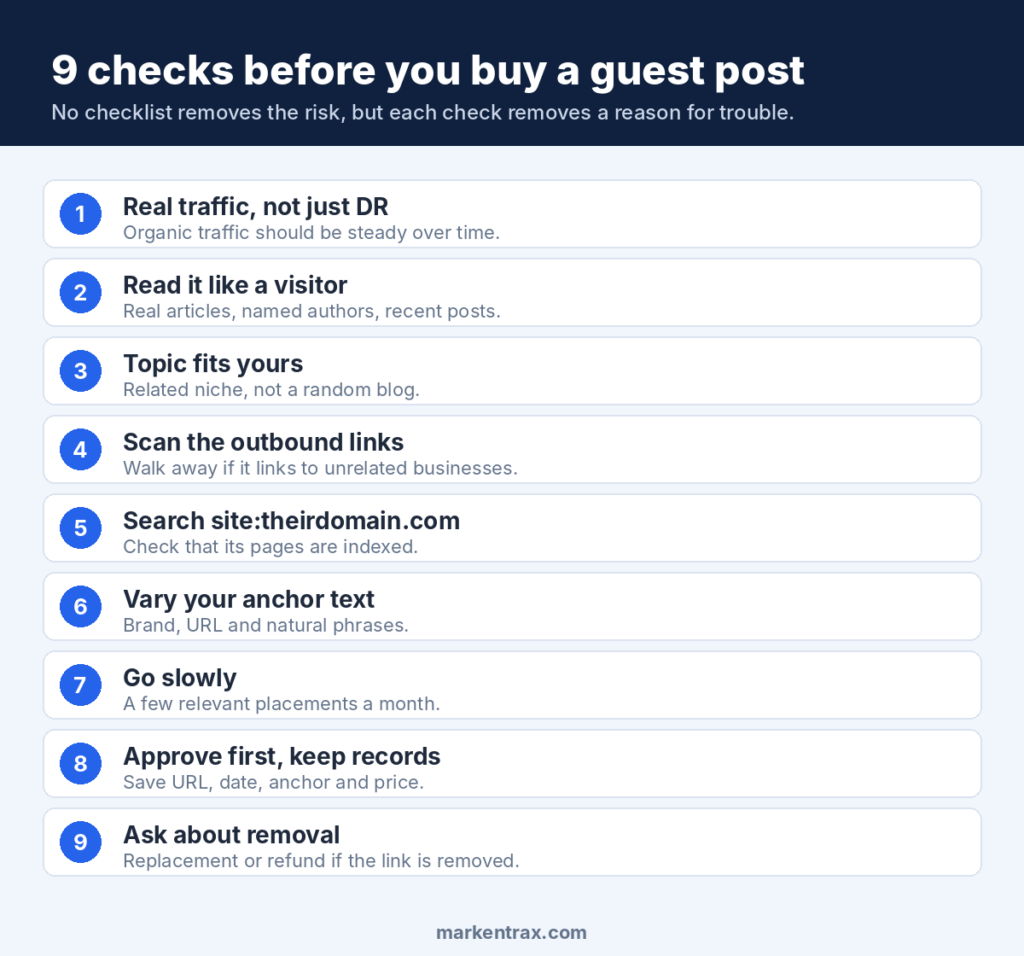
No checklist removes the risk, but each of these checks removes a reason for trouble. Our longer guide on how to vet a guest post site goes deeper on the first four.
- Look at real traffic, not just Domain Rating. Open the site in Ahrefs, Semrush or a similar tool. Organic traffic should be steady over time. A sudden spike, or a sharp fall, is a reason to ask questions.
- Read the site like a visitor. Are there real articles, named authors, an About page and recent posts? Would you stay on it for a minute if you had landed there from search?
- Check that the topic fits yours. A marketing blog linking to a marketing service makes sense. A recipe blog linking to a loan company does not.
- Scan the outbound links. If most posts link out to unrelated commercial sites, or the blog is full of “sponsored post” pieces, walk away.
- Search the site on Google. Type site:theirdomain.com and see whether its pages are indexed. A site that Google barely shows is a poor home for your link.
- Vary your anchor text. Use your brand name, your plain URL and natural phrases. Do not put the same exact keyword on every link.
- Go slowly. A few placements a month, spread across different sites, looks like normal growth. Thirty in one week does not.
- Approve the site before anything goes live, and keep records. Save the URL, date, anchor text, and price for every placement.
- Ask what happens if the link is removed. Links disappear. A seller should be able to tell you in advance whether you get a replacement or a refund.
Sponsored links, followed links and what each one is for
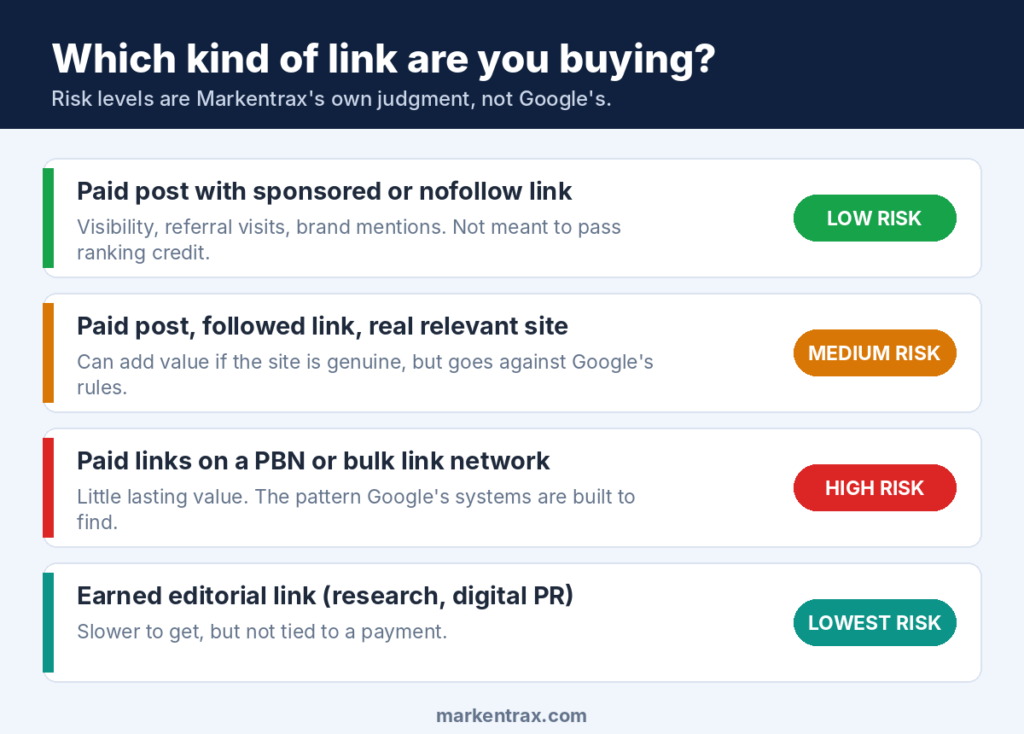
Whether a link is marked is the publisher’s decision, since they control their own site. That is why it is worth asking how a link will be marked before you pay, and deciding with your eyes open. The table shows how the main options compare. The risk ratings are our own judgment, not Google’s.
| Type of link | Risk level | What it is good for |
| Paid post with rel=”sponsored” or nofollow | Low | Visibility, referral visitors and brand mentions. Not meant to pass ranking credit. |
| Paid post with a followed link on a real, relevant site | Medium | Can add value if the site is genuine, but goes against Google’s rules. Risk grows with volume and exact-match anchors. |
| Paid links on a PBN or bulk link network | High | Little lasting value. This is the pattern Google’s systems are built to find. |
| Earned editorial link (original research, digital PR, a genuinely useful article) | Lowest | Slower and harder to get, but not tied to a payment. |
A natural link profile usually holds a mix of followed and nofollow links, because many large sites mark outgoing links that way by default. So a sponsored post is not a wasted purchase. It is just a different kind of value than a ranking boost.
If you do buy, treat paid guest posts as one part of the plan, next to links you earn with good content and press coverage, and keep the numbers modest.
How we handle this at Markentrax
We do not use PBNs. Every placement is arranged manually on a real website, you approve the target site before anything is published, and you receive the live link with a report. If a placement is removed within six months, we provide an alternative post or a refund.
We also will not promise rankings, because nobody honest can. Ask any provider, including us, how your link will be marked and which sites they have in mind before you pay. A clear answer to that question tells you a lot.
Frequently asked questions
Can Google penalize me for buying guest posts?
Yes, it can. Google says sites that break its spam policies may rank lower or not appear in results at all, and that detection involves both automated systems and human review. Links can also be quietly discounted without any notice.
Can Google tell which guest posts are paid?
Google cannot see a payment, but its systems look at patterns, such as sites that sell outgoing links and unnatural link profiles. It is safer not to count on staying invisible.
Is a guest post safe if I do not pay for it?
A real article you write for a relevant site, with a natural link that helps the reader, is the lowest-risk version. Google’s concern is paid placements and links with optimized anchor text spread across guest posts and press releases on other sites.
Should I ask for a sponsored or nofollow link?
If you want to stay fully inside Google’s rules on paid links, yes. The trade-off is that the link is not meant to pass ranking credit, so the benefit is visibility and referral visits.
How many guest posts per month is safe?
Google does not publish a number. A small, steady pace on relevant sites with varied anchor text looks more natural than a large batch. Your site’s age and size matter too, so start modestly and watch the results.
What if I already bought risky links?
Check the Manual actions report in Google Search Console first. If you can reach the sites, ask them to remove the link or mark it as sponsored. Google’s disavow tool exists for these situations, but it should be used with care, ideally after getting advice.
Want guest posts you can check yourself?
Share your niche, target pages and budget, and we will suggest relevant sites that you can approve before anything is published, with a clear price.
Related reading: How Much Does a Guest Post Cost in 2026? | How to Vet a Guest Post Site Before You Buy | Guest Post vs Niche Edit: Which Is Better?